SEO Strategy · Link Building · Authority Building · 2026
What Is Off-Page SEO? How To Do It & Strategies That Work in 2026
14 min read · May 2026 · SEO Strategy & Link Building
Table of Contents
You’ve published great content. Your website loads fast, your headings are structured perfectly, and your meta descriptions are polished. But your Google rankings are still stuck on page two or three — and you can’t figure out why. Sound familiar? You’re not alone, and the answer is almost always the same: you’re missing a strong off-page SEO strategy.
On-page SEO tells Google what your website is about. Off-page SEO tells Google how much the rest of the internet trusts and respects your website. And in 2026, with Google’s ranking algorithms placing unprecedented weight on authority, expertise, and trustworthiness — off-page SEO is no longer the finishing touch. It’s a foundational pillar of any serious digital growth strategy.
This guide explains What is Off-Page SEO? How To Do It & Strategies That Work in 2026— with practical steps, real-world examples, and a clear framework you can start implementing today. If you have ever wondered what is off-page SEO, how to do it, and which strategies that work will actually move the needle for your business, you are in the right place.
92%
of top-ranking Google pages have at least one external backlink pointing to them
3.8×
more organic traffic earned by pages with strong backlink profiles vs weak ones
58%
of SEO professionals say link building is the most challenging part of their work
Google’s quality framework — Experience, Expertise, Authoritativeness, Trustworthiness
📚 Data sources & rationale: Backlink statistics derived from Ahrefs’ study of 1 billion web pages (2024 update). Traffic correlation data from Semrush’s annual ranking factor study. E-E-A-T framework from Google’s Search Quality Evaluator Guidelines (March 2025 update). These figures represent industry averages and correlations — not guarantees of specific outcomes for individual websites.
What Is Off-Page SEO? A Clear Definition
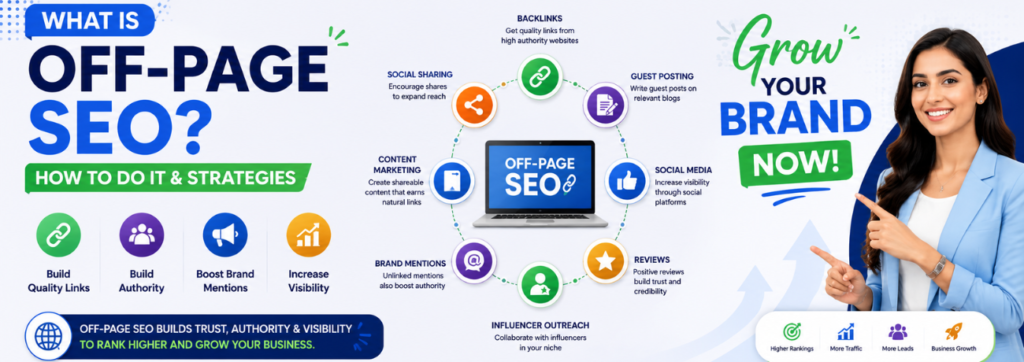
Off-page SEO refers to all the activities you perform outside your own website to improve its authority, trustworthiness, and ultimately its ranking position on Google and other search engines. While on-page SEO optimises your website’s internal content and structure, off-page SEO builds the external signals that tell search engines your website deserves to rank above its competitors.
💡 Simple analogy: Think of on-page SEO as your CV — it describes your qualifications clearly. Off-page SEO is your professional references — the external voices that confirm you’re as good as your CV says. Google weighs both, but the references carry enormous weight in competitive situations.
Off-page SEO encompasses far more than just backlinks. In 2026, Google evaluates a rich ecosystem of external signals including brand mentions, social media engagement, digital PR coverage, review signals, influencer endorsements, and author expertise — all of which contribute to your site’s perceived authority in its niche.
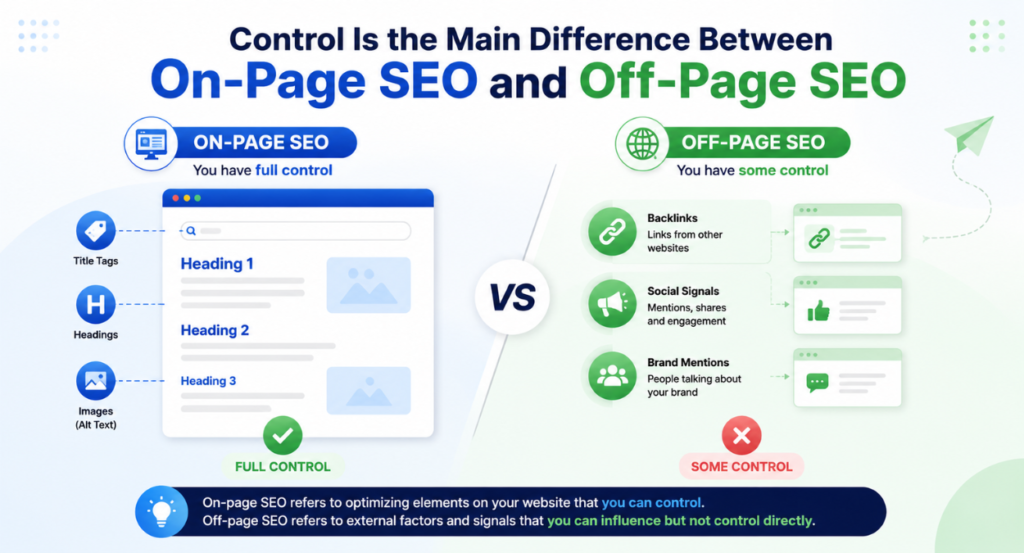
On-Page SEO vs Off-Page SEO: What's the Difference?
Factor | ||
Where it happens | On your own website | Across the wider internet |
What it involves | Content, keywords, meta tags, speed, structure | Backlinks, mentions, PR, social signals, reviews |
Who controls it | Entirely you | Partially you, partially others |
Timeframe | Immediate implementation | Builds over weeks and months |
Primary signal to Google | “What is this page about?” | “How trusted and authoritative is this site?” |
2026 importance | Essential foundation | Critical differentiator in competitive niches |
Why Off-Page SEO Matters More Than Ever in 2026
Google’s algorithm has evolved significantly. With AI-generated content flooding search results, Google increasingly uses off-page signals to distinguish genuinely authoritative sources from content farms. In practical terms: two websites with identical on-page SEO will almost always be separated in rankings by their off-page authority — and that gap can be enormous.
- Google’s E-E-A-T framework (Experience, Expertise, Authoritativeness, Trustworthiness) relies heavily on off-page signals to evaluate content quality — particularly for health, finance, and legal topics where accuracy matters most.
- Domain Authority (DA) and Domain Rating (DR) — composite metrics calculated from backlink profiles — are among the strongest predictors of where a page will rank for competitive keywords.
- Brand signals have become ranking factors: Google now evaluates how often and in what context your brand is mentioned across the web — even when those mentions don’t include a hyperlink.
- Reviews and local citations directly influence local SEO rankings — critical for service businesses, clinics, restaurants, and any business competing for “near me” search traffic.
Want to know where your off-page SEO currently stands? Request a free audit today.
Off-Page SEO Strategies That Actually Work in 2026
Not all off-page activities deliver equal results. Here are the strategies consistently proven to improve rankings, authority, and organic traffic — categorised by priority level:
🔥 High Priority
🔗
Link Building
Earning high-quality backlinks from authoritative, relevant websites. The cornerstone of off-page SEO — quality and relevance matter far more than quantity.
🔥 High Priority
📰
Digital PR & Media Outreach
Getting featured in online news publications, industry blogs, and authoritative media outlets. Generates high-DA links and brand signals simultaneously.
🔥 High Priority
✍️
Guest Posting
Writing expert articles for reputable websites in your industry. Builds authority, earns backlinks, and places your expertise in front of new audiences.
⚡ Medium Priority
⭐
Review Building
Consistently generating authentic reviews on Google, Trustpilot, and industry-specific platforms. Critical for local SEO and E-E-A-T signals.
⚡ Medium Priority
📣
Brand Mention Monitoring
Tracking unlinked mentions of your brand and converting them into backlinks. Tools like Ahrefs Alerts and Google Alerts make this scalable and systematic.
⚡ Medium Priority
📋
Business Directory Citations
Ensuring consistent NAP (Name, Address, Phone) listings across directories like Justdial, Sulekha, IndiaMART, and Google Business Profile.
💡 Advanced
🎨
Linkable Asset Creation
Creating original research, infographics, tools, or data studies that other websites naturally want to link to and share — the most scalable link-earning strategy.
💡 Advanced
🤝
Influencer & Expert Collaborations
Partnering with niche influencers and industry experts to co-create content, earn mentions, and build credibility with both audiences and search engines.
How To Do Off-Page SEO: A Step-by-Step Process
Understanding the strategies is one thing. Executing them systematically is another. To truly master what is off-page SEO, how to do it, and the strategies that work across different campaigns, you need a repeatable framework. Here’s a clear, actionable process for building a strong off-page SEO foundation:
1. Audit Your Current Backlink Profile
Use Ahrefs, Semrush, or Google Search Console to understand your existing backlinks — how many you have, their quality, which domains link to you, and whether any toxic links need to be disavowed. This baseline determines your starting point and priorities.
2. Analyse Your Top Competitors’ Link Profiles
Identify the pages on competitors’ websites that earn the most backlinks and from which specific domains. This reveals your link gap — the difference between your authority and theirs — and provides a concrete target list of websites to approach for your own link building.
3. Create Link-Worthy Content Assets
Before doing outreach, ensure you have something worth linking to. Original research, comprehensive guides, free tools, data visualisations, and expert opinion pieces earn links naturally. Low-value content makes outreach nearly impossible regardless of your networking skills.
4. Launch a Targeted Outreach Campaign
Identify relevant websites in your niche where your content would genuinely add value. Write personalised, concise outreach emails explaining specifically why linking to your content would benefit their readers — not generic “please link to me” requests, which are consistently ignored.
5. Build a Guest Posting Pipeline
Identify 10–15 authoritative industry blogs, news sites, or publications that accept guest contributions. Pitch topic ideas that haven’t been covered well, deliver genuinely expert-level content, and include one natural link back to a relevant page on your website.
6. Implement Local Citation Building
For local businesses, submit consistent NAP information to every major Indian and global directory. Inconsistent citations — different phone numbers, misspelled addresses — actively harm local search rankings and confuse search engine crawlers.
7. Track, Measure, and Refine Monthly
Use Google Search Console to monitor new backlinks and ranking changes. Track Domain Rating (DR) in Ahrefs monthly. Set up Google Alerts for brand mentions. Review which content earns the most links and double down on those formats in subsequent months.
Off-Page SEO: What to Do and What to Strictly Avoid
✅ Best Practices (Do These)
- Earn links from relevant, authoritative sites
- Create genuinely useful content that attracts links
- Build relationships with journalists and bloggers
- Pursue digital PR for high-DA coverage
- Respond to Help A Reporter Out (HARO) queries
- Build consistent local directory citations
- Systematically collect authentic customer reviews
- Convert unlinked brand mentions into backlinks
- Monitor and disavow toxic backlinks quarterly
🚫 Black Hat Tactics (Avoid These)
- Buying backlinks from link farms
- Participating in private blog networks (PBNs)
- Excessive reciprocal link exchanges
- Submitting to low-quality article directories
- Using automated link building software
- Keyword-stuffed anchor text in all backlinks
- Fake review generation schemes
- Spammy forum or comment link drops
- Guest posting on unrelated, low-quality sites
Important note: Black hat off-page tactics may produce short-term ranking improvements, but Google’s Penguin algorithm and manual review teams actively penalise manipulative link building. The recovery process from a Google penalty can take 6–18 months and often requires rebuilding an entire backlink profile from scratch.
Real-World Examples: Off-Page SEO That Delivered Measurable Results
Example 1 — B2B Software Company, Bengaluru
A Bengaluru-based HR technology startup was competing against established players for high-value keywords like “HR software India” and “payroll management system.” Their on-page SEO was strong, but Domain Rating was just 18 — far below competitors averaging DR 45+. After a 6-month off-page SEO campaign focused on guest posting in HR industry publications, digital PR securing features in Economic Times and YourStory, and converting 22 unlinked brand mentions into backlinks, their DR grew from 18 to 34. Organic traffic increased 287% and they achieved first-page rankings for 14 target keywords.
DR 18 → 34 in 6 months +287% organic traffic 14 first-page rankings achieved
Example 2 — Local Dental Clinic, Delhi NCR
A dental clinic in South Delhi was ranking position 12–15 for “dentist in South Delhi” despite having excellent on-page content. The clinic had almost no backlinks and fewer than 8 Google reviews. A targeted off-page campaign focused on local citation building across 35 directories, a systematic review generation programme (collecting 62 Google reviews in 90 days), and three guest articles published on Delhi health and lifestyle blogs moved their Google Maps ranking from position 8 to position 2 within 4 months — increasing monthly new patient calls by 190%.
Maps ranking: 8 →2 62 reviews in 90 days +190% monthly patient calls
Example 3 — E-Commerce Fashion Brand, Mumbai
A Mumbai-based sustainable fashion brand created an original research piece: “The State of Fast Fashion Waste in India 2025” — a data-driven report with compelling infographics. The report was pitched to fashion journalists, sustainability bloggers, and business publications. Within 60 days it had earned 47 organic backlinks from 31 unique domains — including links from The Hindu Business Line, Vogue India’s website, and four major sustainability-focused publications. Their Domain Rating improved from 22 to 29, and organic traffic to their product category pages grew 164% as authority transferred through internal links.
47 backlinks earned organically 31 unique referring domains +164% category page traffic
Essential Tools for Off-Page SEO in 2026
🔍 Ahrefs
Backlink analysis, competitor link gaps, DR tracking, brand mention alerts. The industry’s most comprehensive link intelligence platform.
📊 Semrush
Backlink audits, toxicity scoring, link building outreach tools, and comprehensive competitive analysis in one platform.
📬 Google Search Console
Free and authoritative — shows your actual backlink profile as Google sees it, plus manual action notifications for penalty monitoring.
🔔 Google Alerts
Free brand mention monitoring. Set alerts for your brand name, key executives, and product names to catch unlinked mention opportunities.
📧 Hunter.io
Find verified email addresses for journalist and blogger outreach — significantly improving response rates on link building campaigns.
📰 HARO (Help a Reporter)
Connects journalists with expert sources. Responding to relevant queries can earn backlinks from major national and international publications.
Need help implementing these off-page SEO strategies? Let’s build your authority together.
Frequently Asked Questions: Off-Page SEO
What is off-page SEO in simple terms?
Off-page SEO is everything you do outside your own website to improve how Google perceives its authority and trustworthiness. The most important activity is earning backlinks — links from other websites pointing to yours — but it also includes building brand mentions, generating reviews, getting featured in publications, and establishing your expertise across the web. Think of it as reputation management for search engines.
How long does off-page SEO take to show results?
Off-page SEO is a long-term investment. Most businesses begin to see measurable ranking improvements 3–6 months after beginning a consistent off-page strategy. Domain authority metrics like Ahrefs DR typically update monthly, and ranking improvements often follow DR increases by 4–8 weeks. Local citation building and review generation can show faster results — sometimes improving local pack rankings within 60–90 days of a consistent programme.
Is link building still important in 2026?
Yes — decisively so. Despite the evolution of Google’s algorithm and the introduction of AI-driven quality signals, backlinks remain one of the three most powerful ranking factors identified in every major SEO correlation study. The key shift is quality over quantity: a single backlink from a highly authoritative, topically relevant website can deliver more ranking impact than 100 links from low-quality sources. Link quality, relevance, and anchor text diversity matter far more in 2026 than sheer link volume.
What is the difference between a dofollow and nofollow backlink?
A dofollow link passes “link equity” (also called PageRank or link juice) from the referring site to yours, directly contributing to your domain authority. A nofollow link includes a rel=”nofollow” HTML attribute that tells Google not to pass link equity. While dofollow links are more valuable for SEO, nofollow links from authoritative sites still contribute to brand signals and referral traffic. A natural backlink profile contains both types — an all-dofollow profile can itself be a red flag to Google’s algorithms.
Can social media activity improve my off-page SEO?
Social media links themselves are nofollow and do not directly pass link equity. However, social media activity contributes to off-page SEO indirectly in meaningful ways: viral or widely shared content attracts natural backlinks from people who discover it; social platforms create indexed brand mentions; active social profiles signal to Google that a brand is legitimate and engaged; and social media is often the first channel through which journalists and bloggers discover content they later link to from their own sites.
How many backlinks do I need to rank on Google's first page?
There is no universal number — it depends entirely on your niche, keyword competitiveness, and the quality of backlinks your competitors have. A local service business competing for “dentist in Dwarka” may need far fewer backlinks than a national e-commerce site targeting “buy running shoes online India.” The most accurate approach is to analyse the backlink profiles of the top 5 pages currently ranking for your target keyword and use that as your competitive benchmark — not an arbitrary number.
What makes a backlink high quality?
A high-quality backlink comes from a website that is: (1) topically relevant to your niche, (2) authoritative with a high Domain Rating, (3) not part of a link scheme or PBN, (4) placing your link within editorial content rather than sidebars or footers, (5) using natural, varied anchor text, and (6) on a page that itself receives genuine organic traffic. A single link meeting all six criteria typically delivers more ranking impact than dozens of links that don’t.
Conclusion: Off-Page SEO Is Your Long-Term Competitive Advantage
Understanding what is off-page SEO, how to do it, & strategies that work is the knowledge gap separating businesses stuck on page two from those consistently dominating the first page of Google. While on-page optimisation creates the foundation, off-page SEO builds the authority that makes Google choose your website over every competitor in your niche.
The strategies in this guide — link building, digital PR, guest posting, review generation, brand mention monitoring, and citation building — are not quick fixes or growth hacks. They are the systematic, sustainable activities that compound in value over months and years, creating a ranking moat that becomes increasingly difficult for competitors to cross.
Start with an audit of where you currently stand. Identify your most significant link gaps. Create content worth linking to. And then build relationships, not just links — because the best off-page SEO in 2026 is built on genuine authority, real expertise, and content that earns its place in the conversation.